Mama's Got a Plan:

Maternity Care, Health Insurance, and Reproductive Justice


Mahmoud v. Taylor BOOK REVIEW

Do public school students have the right to prospectively opt out from encountering a book, specifically one that contains LGBTQ+ materials and themes? Yes, according to SCOTUS, who just decided Mahmoud v. Taylor, in favor of parents who objected to a Maryland school district making books available to teachers and students for classroom use and extracurricular reading. These books were not mandated in classroom curricula. As a result of the decision, parents can demand that their children be pre-emptively opted out from encountering these books. You can read more about the case at Lambda Legal.

We at Mama’s Got a Plan think it’s a grand idea to have books that reflect all students. So here is our review of the seven books in question, complete with spoilers. Wikipedia kindly listed them in grade order … so here we go!

Pre-K: Pride Puppy, by Robin Stevenson

An overwhelmingly happy and rainbow-filled ABC book celebrating many positive values – neighborliness, parades, farmers markets, families, dogs.

This is exactly the sort of book to turn a MAGA brain into whipped cream. So many supportive representations of queerness! We find it pictorially a bit overwhelming, but it is an excellent book to prompt discussion of questions that children may have around LGBTQ identities.

Kindergarten: Uncle Bobby’s Wedding, by Sarah S. Brannen

Chloe’s favorite uncle, handsome and endowed with truly beautiful white guy hair (facial and otherwise), announces his engagement to Jamie, to the great delight of the family. Chloe, however, disapproves because marriage would divert Uncle Bobby’s attention away from her. Bobby promises to always love her, and then Bobby and Jamie together charm Chloe with ballet, ice cream sodas, swimming and sailing, and campfires and marshmallows. Chloe yields in the face of their love and attention, allowing Bobby and Jamie to have a picture book (literally!) wedding that everyone enjoys.

This story is not really about gay marriage, but about children dealing with fears of losing the attention of favorite family members who enter new adult relationships. If children cannot stand to see a gay couple in a picture book when the gayness of the couple is not even the theme of the book, they’re going to have a very hard time out in the world once they leave their cloistered community – in which gay couples also exist, if only in the closet.

1st grade: IntersectionAllies: We Make Room for All, by Carolyn Choi and Chelsea Johnson

A thorough explanation of intersectionality and allyship, shown through the eyes of children. Kimberlé Crenshaw, the originator of the intersectionality framework, wrote the foreword. A couple of choice phrases: “We can listen to and support each other in ways that unite us across differences.” “I believe we are strongest when we build communities that are found on the understanding that we have a stake in each other.” Who can argue with that?

A lovely feature of this book is the portrayal of children helping each other, their own families, and one another’s families in situations involving ability status; childcare; gendered clothing and religious garb (hijab); racialized violence (police state); ecology, conservation, and protection of Native Americans; immigrant families, including those fleeing war and violence; language barriers and multilingual families; and citizenship status.

Although listed as a first-grade book, the materials at the end (definitions, notes, and discussion guides) make this an excellent book for children to refer back to as their understanding grows throughout their school years.

2nd grade: My Rainbow, by DeShanna Neal and Trinity Neal

Through the lens of Trinity, the main character, who is Black, on the autism spectrum, and a transgender girl, we see examples truly exceptional parenting.

Trinity feels she needs long hair. The problem is that she cannot stand the feeling of her hair growing out. Her family listens carefully but doesn’t know what to do – until cello-playing brother Lucien comes up with the idea of a wig. Her mother takes the idea even further and stays up until the wee hours creating what Trinity needs. The book concludes with a very happy Trinity and the family expressing love. This one made us sniffle. The book shows the reader that when there aren’t simple solutions, with enough love and creativity and dedication people can find the answer.

In addition, this book engages all the senses with its vibrant illustrations and music running behind the words.

3rd grade: Prince & Knight, by Daniel Haack

The King and Queen feel that Prince – again with the gorgeous hair! – won’t be able to govern alone: the kingdom is simply too big. They travel far and wide to introduce him to various ladies, but “it was soon clear that he was singing a different tune.” When news comes to them that a dragon is threatening the kingdom, Prince races home on his horse. When he is just about to engage the dragon, a knight appears and temporarily blinds the dragon with his shining armor. Prince climbs on top of the beast and subdues it, but in the process is knocked off. Dragons are big, so it’s a long fall, but Knight races on his horse just in time to catch Prince – very romantic! Knight is revealed to be another hot guy with gorgeous hair, and the two men immediately fall in love. Upon returning home, the two lovebirds are accepted and celebrated by the entire community.

This was our least favorite of these books. It is a problematic time to be celebrating monarchy, especially when non-royalty (here, the villagers) are consigned solely to fearing the dragon or cheering Prince and Knight. We don’t really get to know anyone – we don’t even learn Prince’s name! But more importantly, the conflict in this story – Prince’s gayness – is shown as simple and simply solved, which even third-graders will identify as improbable. It’s all very Disney-like, but without challenging any of the foundational beliefs that underlie Disney. The illustrations are Disney-simple too. Perhaps this is a good alternative in a fictional universe filled with Snow Whites and Cinderellas, but we wanted more.

4th grade: Love, Violet by Charlotte, by Sullivan Wild

Violet likes her classmate Mira, who shows every sign of liking her back, but Violet is too shy to tell Mira or even accept Mira’s invitations to play together. To explain her feelings, Violet makes Mira a sparkly, glittery Valentine, but cannot bring herself to deliver it. As in a standard rom-com, Violet is clumsy and tongue-tied, earning the mockery of her classmates – who frankly sound like a bunch of hooligans who should be kept in at recess and required to write “I will behave like a mensch” 500 times. Is it Violet’s hint of mannish dressing that sparks their cruelty? This is never addressed. In the end, Violet and Mira exchanges Valentines and become the best of friends.

It’s a sweet story and the illustrations are dynamic. But again, the problem is simple and the solution equally so. Where are the parents? The teachers? The neighbors? Lord of the Flies it isn’t, but the story conveys a sense of isolation and hopelessness in the way the schoolchildren interact. We want a larger conversation about how to bring all the children along, not just a love/like story.

5th grade: Born Ready: The True Story of a Boy Named Penelope, by Jodie Patterson
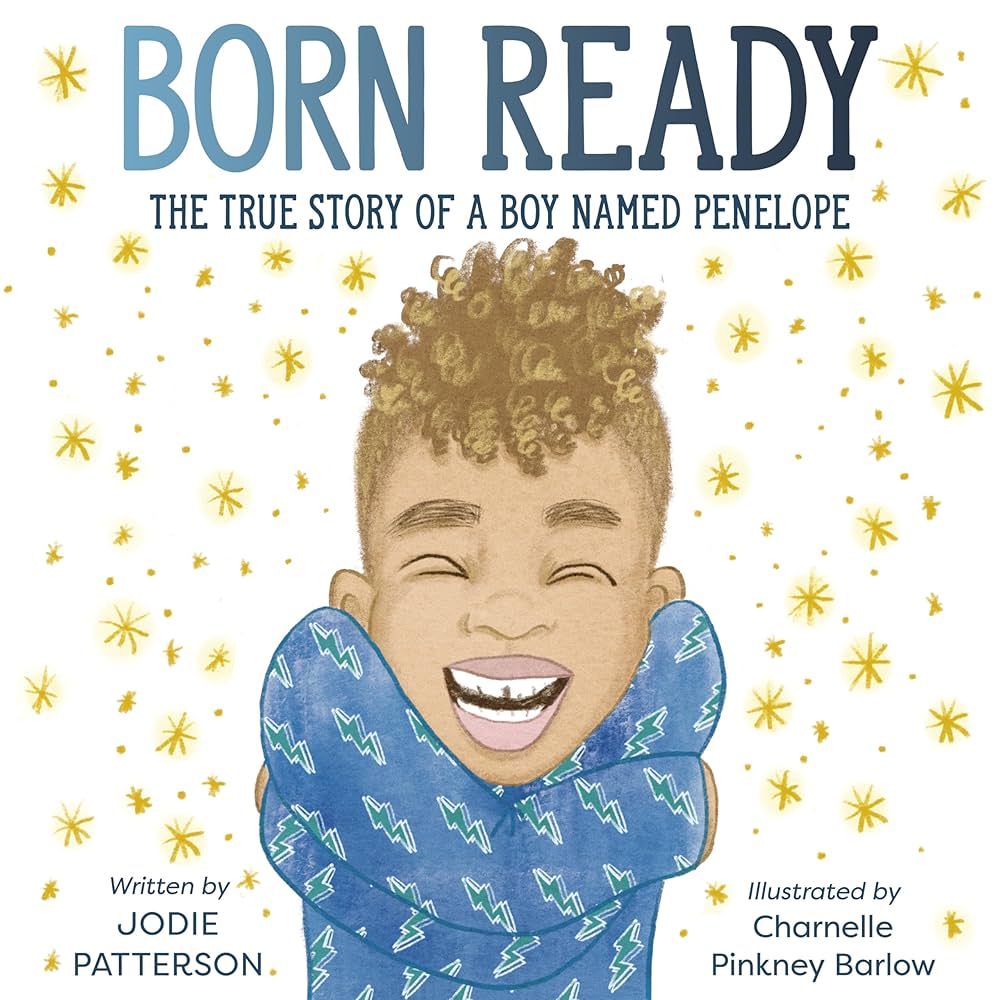
In the middle of a busy family, Penelope knows himself to be a boy. In frustration at not being seen, he misbehaves until his mother discovers his feelings. At first she responds insufficiently, telling him that whatever he feels on the inside is fine. Penelope responds that he doesn’t feel like a boy, he is a boy. To her credit, his mother not only validates him, but makes a plan to tell everyone. Penelope: “For the first time, my insides don’t feel like fire. They feel like warm, golden love.” Again, sniffle! Penelope gets the short haircut he wants, and his mother follows through at his birthday party by explaining his new identity to his grandfather from Ghana. Grandpa responds that in his native language, there are no gendered pronouns – “…gender isn’t such a big deal.” Score! However, the story is not over. Older Brother doesn’t believe Penelope can become a boy just by saying so. Mama wisely explains that not everything has to make sense. “This is about love.

At school, Penelope wears his boy’s uniform and his status is acknowledged by his friends. In an endearing interchange, the principal asks Penelope if he is a boy, and when he confirms the change, the principal says, “Well, Penelope … today you’re my teacher.” The book concludes with Penelope studying karate and owning his power.

This is more like it! Everyone is involved in Penelope’s decision – his immediate family, his grandfather, his schoolmates, his principal. Just as in My Rainbow, this is a portrait of a loving Black family who knows when to stop and listen, and who understands that a decision about identity is not made in isolation, but in community. We loved this book!

CONCLUSION

These seven books all have something to recommend them, although it should be clear from our reviews where our preferences lie. In addition to depictions of LGBTQ individuals and families, most of the books featured excellent representations of varied abled status, race and ethnicity, and age. Most could use improvement in depictions of different body shapes and sizes.

The parents who brought this lawsuit and the justices who found for the parents are, in our opinion, short-sighted at the very least and bigoted and hateful at the worst. In our own schooldays, did we encounter books that did not reflect our family’s religious, moral, and political views? Yes, pretty much everything in the Western canon! However, the point of education is not that students avoid encountering material they disagree with, but that they experience a broad array of materials while developing critical thinking skills so they can evaluate materials in light of their own and their families’ principles, as well as by diverse standards of quality.

We urge you to sample these books! Visit your local library to request the acquisition of these titles if they are not already in the collection, explore interlibrary loan options, and patronize local independently-owned booksellers.


Dobbs after Roe

As the Dobbs regime succeeds Roe, the flames creep closer to everyone.

width="1100"


The end of an era

With this year’s decision in Dobbs v. Jackson Women’s Health Organization, SCOTUS has ended an era that began with Roe v. Wade in 1973. The action to which the decision has spurred outraged Americans is a silver lining, especially as activist energy extends to other legal regimes deserving of attention. Voting rights? Immigration law? Responses to climate change? One can hope. Without undervaluing the importance of abortion rights, however, we can also admit that Roe, as well as its subsequent line of cases, was not without problems.

Roe‘s problems

The decision’s grounding in the right to privacy, as pulled from the Bill of Rights – or thin air, as per opponents – did not offer the soundest protection. (For other theories of abortion rights, see here. For an examination of privacy and poverty, see this book by the brilliant Khiara Bridges.) Roe also contained language that placed at least some decision-making capacity In the hands of the physician rather than the pregnant person, and used a trimester measurement that reflected only a chronological marker rather than a substantive reason for restricting abortion. It took no notice of the existing uneven access to abortion, similar to access to other health care services. In 1992, Casey v. Planned Parenthood replaced the trimester measurement with “viability,” a moving target due to ever-improving medical developments to treat the neonate. Casey introduced a new legal standard: states were not permitted to restrict abortion for pre-viability pregnancies in ways that presented an “undue burden.” However, subsequent cases failed to rule out most restrictions as undue burdens. Pregnant people apparently suffered no undue burden by being forced to travel long distances with a forced overnight stay so that they might be read a state-mandated script on the alleged risks of abortion and then wait 24 hours to let it sink in before their procedure might begin. In many states, access to abortion under Roe and then Casey was no cakewalk.

Roe‘s OTHER problems

Equally onerous, but much less remarked by the pro-choice movement, was Roe’s misapplication to pregnant people who wanted to continue their pregnancies. How did that work? Roe granted states an increasing “interest in the fetus” over time: states were granted the ability to restrict abortion the farther a pregnancy advanced. Unfortunately, various segments of law enforcement and the judiciary misinterpreted abortion law to mean that states also had an interest – that is, a right to interfere – in pregnancies carried to term. The result has been any number of state interventions, from railroading pregnant people into cesarean surgery, threatening them with child abuse and neglect investigations for failing to fall in line with medical recommendations, all the way to the criminalization of pregnancy, in which Black and Brown people especially are prosecuted if they are found to have used drugs and/or their pregnancies do not result in a perfectly healthy child, even lacking any evidential causal relationship between the two circumstances.

Roe’s demise, far from removing this misapplication, shifts it earlier in the pregnancy. Who can say now when the state’s interest in the prenate begins? When, in fact, does the prenate’s life begin? (That question is examined in this post.) And how early in the life of a person with even the appearance of a future capacity for pregnancy might the state step in? What might the state do now to maintain control over reproduction while continuing to feed the racist prison-industrial complex?

Lace up those boxing gloves!

The moral of this story: Pregnant people possess a common interest, whether they intend to terminate their pregancies or carry them to term. It is in the interest of anyone with a desire to protect reproductive rights, whether that be the right to have children, the right not to have children, and the right to raise children in safety and with dignity, to fight like hell against legal regimes that allow the state to impose restrictions for which pregnant people will bear the consequences.


Image credits

All images are shared under a Creative Commons license, unless otherwise noted. Where required by license, changes to the image are noted.


A new world

A heartfelt reaction to a performance of the opera, Octavia E. Butler’s Parable of the Sower.

220125 audit mi

Click image to open larger version in new window.

Further reading

Octavia E. Butler’s Parable of the Sower is an opera written by Toshi Reagon and Bernice Johnson Reagon. If you are lucky enough to have a performance available to you, grab a ticket right away! Read more about the opera here and be sure to read both the novel and the graphic novel, and to listen to the podcast hosted by Toshi Reagon and adrienne maree brown.

A word about the images that make up the Love Letter: A photo of Sweet Honey in the Rock was placed behind the photo of Toshi Reagon, even though the group was not involved in the opera. However, Bernice Johnson Reagon, the leader of Sweet Honey in the Rock, is the co-author of the opera; the photo was used as a tribute to her, and to the style of music that the opera grew from. 

Image credits

All images are shared under a Creative Commons license, unless otherwise noted. Where required by license, changes to the image are noted.


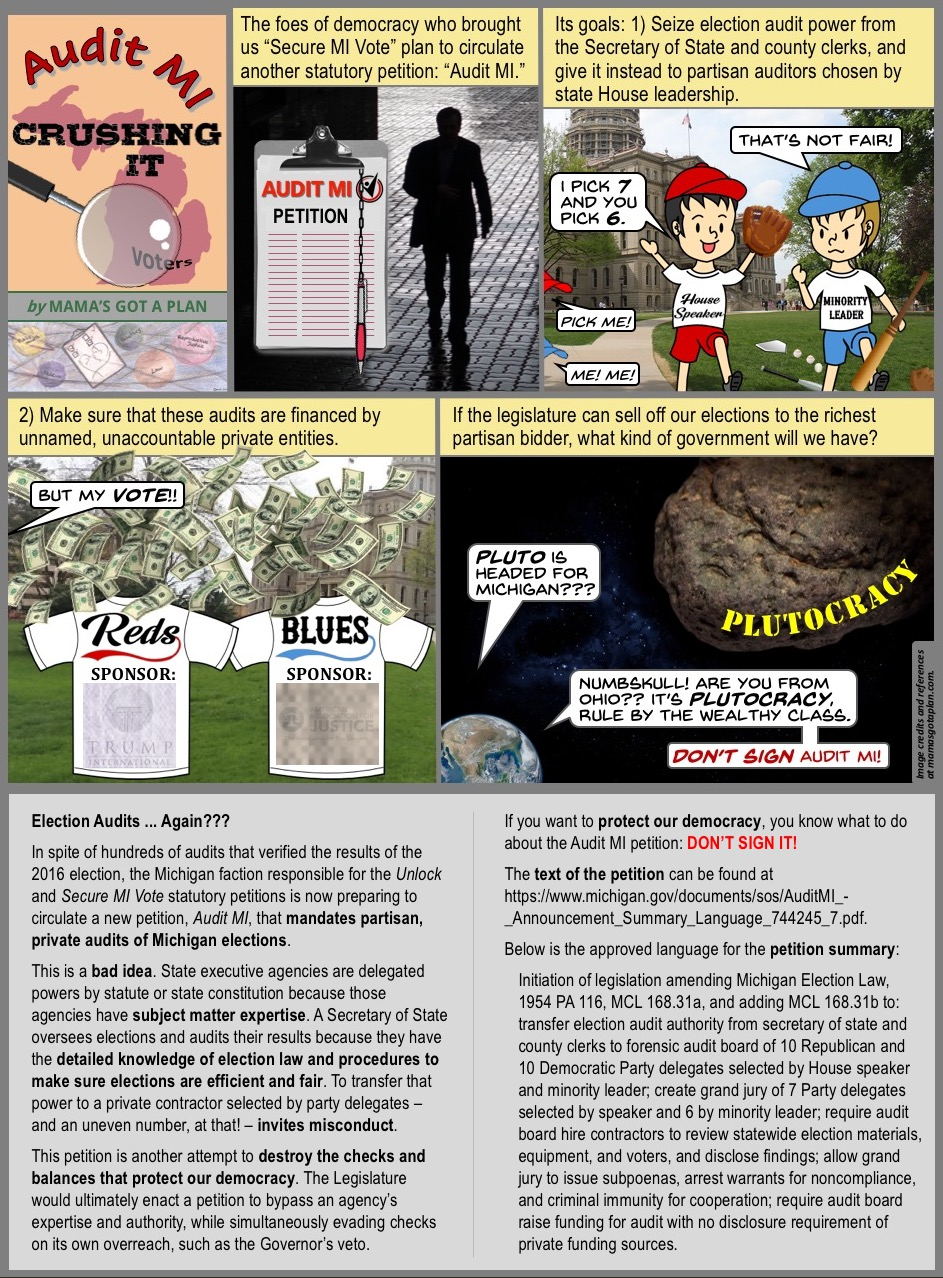
The crushing weight of Audit MI

Michiganders must crush this attempt to sell our elections to the highest partisan bidder.

Do not sign the petition!

220125 audit mi

Click image to open larger version in new window.

Further reading

Image credits

All images are shared under a Creative Commons license, unless otherwise noted. Where required by license, changes to the image are noted.


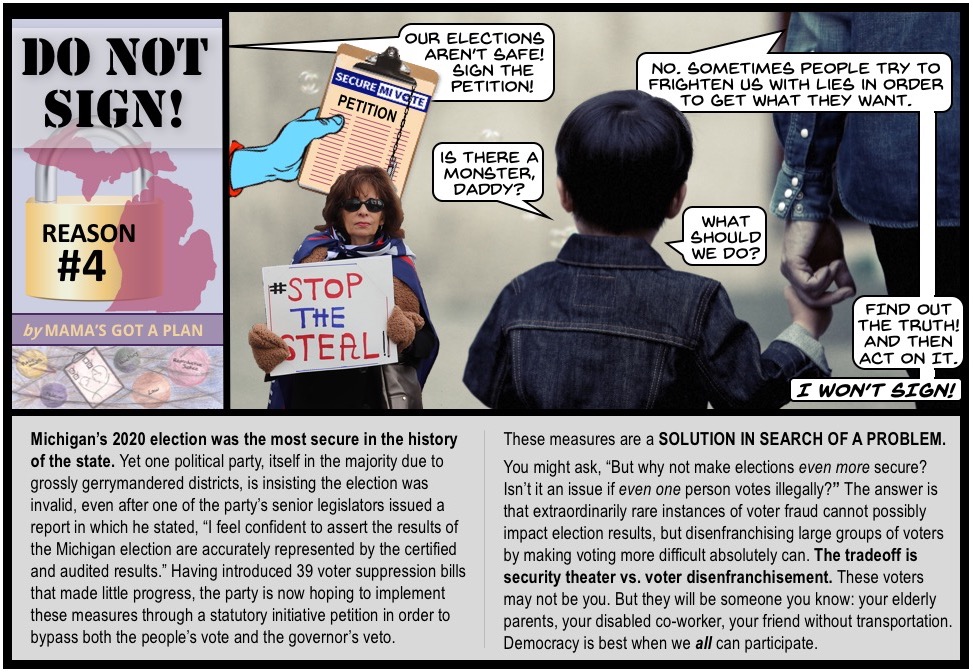
Securing ourselves out of a vote, #4

This is the fourth and final installment in a series of cartoons warning voters not to sign the Secure MI Vote petition.

The so-called “Secure MI Vote” petition currently being circulated puts barriers in the way of Michigan voters, particularly voters already vulnerable to disenfranchisement.

If you have ever locked yourself out of your house or your car, consider that this is exactly the kind of “security” this petition stands for.

Do not sign the petition!

C

Click image to open larger version in new window.


Further reading

Image credits

All images are shared under a Creative Commons license, unless otherwise noted. Where required by license, changes to the image are noted.

  • The “Stop the Steal” protestor is from a photo by Elvert Barnes. The figure was isolated from other protestors and background images.
  • The photo of parent and child is from pxfuel.com.


Securing ourselves out of a vote, #3

This is the third in a series of cartoons warning voters not to sign the Secure MI Vote petition.

The so-called “Secure MI Vote” petition currently being circulated puts barriers in the way of Michigan voters, particularly voters already vulnerable to disenfranchisement.

If you have ever locked yourself out of your house or your car, consider that this is exactly the kind of “security” this petition stands for.

Do not sign the petition!

C

Click image to open larger version in new window.


Further reading

Image credits

All images are shared under a Creative Commons license, unless otherwise noted. Where required by license, changes to the image are noted.


Securing ourselves out of a vote, #2

This is second in a series of cartoons warning voters not to sign the Secure MI Vote petition.

The so-called “Secure MI Vote” petition currently being circulated puts barriers in the way of Michigan voters, particularly voters already vulnerable to disenfranchisement.

If you have ever locked yourself out of your house or your car, consider that this is exactly the kind of “security” this petition stands for.

Do not sign the petition!

C

Click image to open larger version in new window.

Further reading

Image credits

All images are shared under a Creative Commons license, unless otherwise noted. Where required by license, changes to the image are noted.


Securing ourselves out of a vote, #1

This is first in a series of cartoons warning voters not to sign the Secure MI Vote petition.

The so-called “Secure MI Vote” petition currently being circulated puts barriers in the way of Michigan voters, particularly voters already vulnerable to disenfranchisement.

If you have ever locked yourself out of your house or your car, consider that this is exactly the kind of “security” this petition stands for.

Do not sign the petition!

CClick image to open larger version in new window.

Further reading

Image credits

All images are shared under a Creative Commons license, unless otherwise noted. Where required by license, changes to the image are noted.


All the controversies at once!

What this cartoon is not about

  • Abortion, and whether it’s good or bad to have one.
  • Vaccines, and whether it’s good or bad to have one.

People will and do differ on these questions. This cartoon assumes that you want to do the good thing, whatever that is, and that a bad thing is mistreatment or exploitation of people of Color based on racism, whether intentional or not. Are we clear?

What this cartoon is about

C"Click image to open larger version in new window.

<a href="https://mamasgotaplan.com/wp-content/uploads/2021/06/210609-one-moral-concern.jpg&quot; alt="C" width="1018" ><img="" class="wp-image-2081 size-full aligncenter" style="margin-bottom: 0;" title="CLICK TO ENLARGE!"

<a href="https://mamasgotaplan.com/wp-content/uploads/2021/06/210609-one-moral-concern.jpg&quot; alt="C" width="1018" ><img="" class="wp-image-2081 size-full aligncenter" style="margin-bottom: 0;" title="CLICK TO ENLARGE!" Some people with concerns about the safety or efficacy of vaccines object to the presence of “aborted fetal cells” in vaccines. However easy (and gruesome!) it is to picture a dismembered hand pushing up through a syringe’s liquid, that is not the reality. As the blue-jacketed person in Frame 3 tries to point out, what is in question are cell lines. How are cell lines formed? Scientists use cells taken from an organism, e.g. kidney cells taken from a dead human embryo, and create a replicating cell line. The original kidney cells eventually die off, just as cells in the body do, and are replaced by genetically identical cells created by standard biological cell division. These cells are then combined with viruses and used to create a vaccine. (For fascinating photos of human embryonic stem cells, see here.)

Given this significant distance in both time and nature between embryo and vaccine, what are the moral and practical grounds for boycotting the vaccine because of this association? Those who wish to discourage abortion will not do so by refusing vaccines; the abortions that created the cell lines involved took place decades ago. Should a scientist decide to create a new cell line from embryonic material, current U.S. ethical rules1 forbid the solicitation of pregnant people to terminate pregnancies for the purpose of supplying material for scientific research. People will no doubt continue to terminate pregnancies and the products of conception might subsequently be donated to science, but disrupting that relationship will not prevent abortions. 

Do boycotts ever work?

1979 divestment protest, University of Michigan

Boycotts have been effective in other circumstances. Starting in the 1970s, a divestment movement demanded that global institutions isolate South Africa from external trade and investment as a way of pressuring the regime to break down its racial Apartheid system. It worked! South African carried out reforms, a civil war was averted, a Truth and Reconciliation commission took place, and eventually Nelson Mandela became president. By the mid-1990s, Apartheid was no more. In South Africa’s case, the objectionable behavior – the subjugation of a majority of the citizenry – was ongoing. The intense financial pressure applied in the boycott served as an incentive for the government to change its behavior.

Harm that can be redressed – but how?

Other wrongs, however, remain to be righted: consider the case of Henrietta Lacks. The HeLa cell line was developed from cells taken from the cervical tumor that killed Lacks in 1951. The line has been successfully used for far-reaching discoveries in cancer drugs, space research, and immunology, including in the study of COVID-19 in search for a vaccine. The moral issue arises from the fact that while great good came of the establishment of the line, none of that good was directed specifically toward the Lacks family.

The cell line was created from cells taken from Henrietta Lacks, all without the knowledge or permission of the the Lacks family. This practice was and is perfectly legal, as validated by a 1990 California case: the court found that patients do not own any blood or tissue samples taken from their bodies, nor do they possess a right to share in profits from research activities that made use of those samples. However, in HeLa’s case it is difficult for us to ignore the vast gulf between the sums generated by the cell line and the reality of the lives of the Lacks family, who were African-American tobacco farmers in Virginia at a time of blatant racial discrimination. Because such inequalities continue and magnify down through the generations, this injury can be considered an ongoing one.

Should we refuse COVID vaccines because of what was done to the family of Henrietta Lacks? The last panel of the cartoon shows the absurdity of such a proposal: even if it were possible to discard the findings of the space program (!), how would such an action help the Lacks family? 

Restorative justice

Let’s try that again.

The concept and practice of Restorative Justice provides a way to compensate victims of injustice, while simultaneously working to prevent future similar injustices. Once used primarily as an alternative within the criminal justice system to address individual instances of property crime, Restorative Justice is now beginning to be deployed more broadly to tackle systemic injustice and inequity.2 The Restorative Justice framework would dictate compensation for the Lacks family and a strategy to reform medical research so that research subjects, particularly those whose bodies were historically used for others’ profit, would be assured of enjoying the benefits of the research. 

Following the publication of Rebecca Skloot’s 2010 book on Henrietta Lacks, her descendants established a foundation to “preserve her legacy by educating future generations on the impact of her phenomenal HeLa cells while promoting health equity and social justice.” In fact, August 1, 2020 marked the beginning of a year’s “Cellebration” of the 100th anniversary of Henriette Lacks’s birth. Today, February 14, 2021, the day of this blog post, the foundation suggests a donation of $14 as a “V-Day gift.” It is also worth noting that the foundation actually advocates for receiving the COVID-19 vaccine as a way to honor the legacy of Henrietta Lacks.

Similarly, those who wish to decrease the number of abortions might also consider a Restorative Justice approach. All birthing people, but especially people of Color, who are disproportionately represented among people terminating pregnancies, should be guaranteed sufficient health care access and financial support so that those who wish to do so can carry their prenates to term and parent all their children in safety and with dignity. Data from the Guttmacher Institute, as reported by CBS News, suggest that the inability to afford a baby is a reason for 73% of women who obtain abortions. Obviously, the fate of prenates who were not carried to term cannot be changed. But the fate of birthing people can. It would make sense for everyone, whatever their position on abortion, to support organizations that fight to improve circumstances for birthing people and their children, like Mothering Justice, Black Mamas Matter Alliance, and others

One moral concern?

Finally, regardless of the utility of boycotts and the application of a restorative justice lens to problems of fairness and equality, is there ever a world in which one moral concern can override all others? You might believe, for example, that your cause in life is to save elephant species from extinction. They are beautiful, intelligent animals, and you are sure they have souls. You might feel moved to decline a vaccine because it was created using, say, cells from elephant ivory,3 which poachers obtain by killing the animals. But to ignore all other issues – climate change, political unrest, or a world pandemic, perhaps? – not only means  that an opportunity to save the elephants might elude you, but also suggests a lack of connectedness to the larger world. Friends, the world needs many things. We our connected to our natural world and to one another. Please, let us consider multiple viewpoints and multiple approaches for our mutual aid.

Updated June 9, 2021: graphic replaced and small stylistic changes made

1The Common Rule (45 CFR part 46), the Federal Policy for the Protection of Human Subjects, was established in 1991. It is enforced by research institutions through Institutional Research Boards. Note that the Common Rule applies only to medical research, not medical practice.

2“Restorative justice began as an effort to deal with burglary and other property crimes that are usually viewed (often incorrectly) as relatively minor offenses. Today, however, restorative approaches are available in some communities for the most severe forms of criminal violence: death from drunken driving, assault, rape, even murder. Building upon the experience of the Truth and Reconciliation Commission in South Africa, efforts are also being made to apply a restorative justice framework to situations of mass violence. These approaches and practices are also spreading beyond the criminal justice system to schools, to the workplace and religious institutions. Some advocate the use of restorative approaches such as circles as a way to work through, resolve and transform conflicts in general.” Zehr, Howard. The Little Book of Restorative Justice: Revised and Updated. New York: Skyhorse Publishing Company, Incorporated, 2015. See also “Restorative Justice as a Social Movement,” in Mark Umbreit and Marilyn Peterson Armour, Restorative Justice Dialogue: An Essential Guide for Research and Practice, 2010.

3Completely fabricated, in order to make a point.

Further reading

Image credits

All images are shared under a Creative Commons license, unless otherwise noted. Where required by license, changes to the image are noted.


What’s your subject?

E-mail senders provided by random name generator at https://www.name-generator.org.uk/quick/.