Mama's Got a Plan:

Maternity Care, Health Insurance, and Reproductive Justice


Ask the Right Question: The Safety Question — Friends of Michigan Midwives

We begin here reblogging a number of cartoons we created for other organizations.
This is the first cartoon in the Ask the Right Question series created for Friends of Michigan Midwives in early 2016.


[Updated July 16, 2016, to add copyright designation.]

via Ask the Right Question: The Safety Question — Friends of Michigan Midwives


A Third Amendment theory of abortion rights

third-amendment-abortion-theory-p1

third-amendment-abortion-theory-p2

This cartoon grew out of the study of different constitutional theories of abortion rights, some better known than others. The First and Second Amendments of the Constitution have infiltrated the popular imagination, but the Third -? What is the Third Amendment, anyway?

Frame 1. The soldier in the title frame is General John Burgoyne, as shown in his portrait by Sir Joshua Reynolds, c. 1760.

Frame 2. Justice William O. Douglas first articulated the Privacy framework in the case of Griswold v. Connecticut (381 U.S. 479 (1965)), which concerned not abortion rights, but the right of married couples to use contraception. As Privacy is not a right specifically named in the Constitution, Douglas introduced the concept of a penumbra, a shadow or cloud emanating from the Bill of Rights, chiefly the First Amendment. Privacy was defined as preventing the government from interfering with marital privacy. This protected area was later expanded to rights to contraception for unmarried people, and then to abortion rights (see Roe v. Wade, 410 U.S. 113 (1973).

Frame 3. Justice Ruth Bader Ginsburg believed that abortion rights were better protected by the Fourteenth Amendment’s Equal Protection Clause:

“… legal challenges to undue restrictions on abortion procedures do not seek to vindicate some gen­eralized notion of privacy; rather, they center on a woman’s autonomy to determine her life’s course, and thus to enjoy equal citizenship stature.”
Gonzales v. Carthart, 550 U.S. 124 (2007), dissent

Ginsburg’s critique of Roe‘s constitutional basis is described in greater detail in this article. Neil S. Siegel and Reva B. Siegel, in their 2013 journal article, “Equality Arguments for Abortion Rights,” further explore the Equal Protection argument by quoting Justice Blackmun’s dissent in Planned Parenthood  v. CaseyBlackmun asserts that the Court’s assumption that women “can simply be forced to accept the ‘natural’ status and incidents of motherhood—appears to rest upon a conception of women’s role that has triggered the pro­tection of the Equal Protection Clause.”

Frame 4. According to the History Channel, the photo of African-Americans in the cotton fields represents a “slave family standing next to baskets of recently-picked cotton near Savannah, Georgia in the 1860s.” The realities of slavery with respect to women’s reproduction has been ably addressed by Dorothy Roberts and Rickie Solinger, who discuss both the coercive nature of these women’s pregnancies as well as their subjugation to the role of producers of future slaves.

The connection to abortion rights is the Thirteenth Amendment, which forbids slavery and involuntary servitude. Legal scholar Andrew Koppelman, in his 2012 article, “Originalism, Abortion, and the Thirteenth Amendment,” draws an analogy between the forced labor of slaves, including their forced reproduction, and the forced labor of women compelled by abortion bans to carry their pregnancy to term. Of course, Koppelman is not claiming that absence of abortion access is equivalent in severity to the past system of slavery in this country, only that both issues can be seen as a violation of the Thirteenth Amendment.

Frame 5. The crowd at the 2004 March for Women’s Lives seems puzzled by the Third Amendment. The photo of the march by Bubamara, shared under a Creative Commons license, is augmented by an airplane towing a “Keep Abortion Legal” sign.

Frame 6.  At last! All is explained! The Third Amendment forbids the forcible housing of military personnel in  citizens’ homes. Its incorporation in the Bill of Rights was a reaction by the Founders to that very practice carried out by the British during the Revolutionary War. The home pictured here is the Brewster House of Setauket, New York, built in 1665. The photo is by Iracaz, shared under a Creative Commons license. The reluctant B&B host is taken from a work housed in the New York Public Library. She is Elizabeth Zane, whose exploits are detailed here; apparently, she was the inspiration for Zane Grey’s Betty Zane (1903), the first volume of his Ohio River Trilogy.

Frame 7. The Guttmacher Institute, one of the prime sources of U.S. abortion data, lists state abortion restrictions enacted during the last several years. The old woman in the shoe, it is surmised here, has so many children that she doesn’t know what to do because of these abortion restrictions. She accuses the state of forcibly housing a fetus in her uterus.

Frame 8. Prepare for a romp through property law, Dear Reader! (Remember, don’t go to law school.) We apply this question: when can someone else be in your home? In this frame, the fetus is compared to a guest who has been invited but is now being asked to leave – as is acceptable at common law, under which tenants or guests of property owners possess relatively few rights. The scene shown, for those who came of age after reruns of The Jeffersons ceased, is of Mr. Jefferson ejecting Mr. Bentley. The dialog, however, is taken not from The Jeffersons, but from The Spellbinders Collection. Our thanks to Ed G. for suggesting this source.

Frame 9. On the other hand, perhaps the fetus is more like a tenant delinquent in rent payments and now facing eviction, as shown in this 1892 painting, Evicted, by Danish artist Erik Henningsen. This image is in the public domain. This comparison highlights the uncompensated nature of women’s labor: the fetus, after all, gives no consideration in exchange for housing – and neither does the state that imposes abortion restrictions.

Frame 10. We move on to trespassing. Harrison Ford, as President James Marshall, spends most of Air Force One (1997) playing hide-and-seek with a deadly group of planenappers. When the president finally gets Gary Oldham (“Ivan”) in his clutches, Ivan finds himself violently pushed off the plane. We show the classic line in a still from another scene (in which the president growls, “Leave my family alone!”). The true scene of Ivan’s end is here. It is worth mentioning that property owners are discouraged from using self-help to eject trespassers; since the president had no sheriff accessible, he can probably be forgiven for taking matters into his own hands.

Whether the fetus is trespassing on the pregnant person is an interesting philosophical question. However, given that almost half of all U.S. pregnancies are unplanned, it is fair to say that in many cases the fetus is present against the pregnant person’s wishes.

Frame 11. Even a person who comes on the land without the owner’s permission may gain some property rights. A prescriptive easement is granted when a person takes adverse possession of the land: their use of the land is open, notorious, and hostile. That is, they use the land openly and against the owner’s wishes, continuously over the course of a statutory period defined by the state. At the end of this period, they are granted an easement to be on the land.

In Michigan, the statutory period is fifteen years. Therefore, we show a fifteen-year-old fetus establishing a Disco in Utero. Even if she is there without her mother’s permission, may she invoke the law in continuing to occupy the space, operate strobe lights and loud music, and dance all night?

Confirmation of the Michigan fifteen-year statutory period led to immediate thoughts of a prenatal quinceañera celebration. Alas, there is not room here to explore this idea; the concept will have to be set aside for another cartoon. Forewarned!

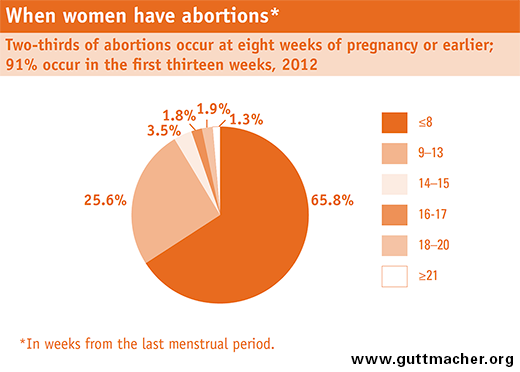
Please note that this image is the only instance in this cartoon of a visibly pregnant person. That is because 65% of abortions in the U.S. are carried out by eight weeks’ gestation, before most pregnancies have begun to show at all. In fact, 91% of all abortions are carried out by thirteen weeks, still very early in a typical 40-week pregnancy. We felt that a fifteen-year gestation, on the other hand, really demanded a visibly pregnant person.

Frame 12. The final frame shows a 1787 painting of the Hartley family, by Henry Benbridge. We discovered this painting on the blog 18C American Women, maintained by art historian Barbara Wells Sarudy; we later tracked it down to the collection of the Princeton University Art Museum.

The ladies of Family Hartley are declaring their autonomy and personhood as an explanation of why an analogy of the fetus to an occupier of maternal land must ultimately fail. To separate pregnant person and fetus as conflicting entities – occupier and occupied – is tempting but unsound. As explained by the authors of Laboring On: Birth in Transition in the United States, mother and fetus constitute a bonded dyad.

A fetus is neither property nor a legal person, but a potential person. Women are not houses, airplanes, or discos. The fetus is not their possession, but part of them. The reason that pregnant people are the best decision-makers about abortion – or childbirth, for that matter – is that they are the experts. They hold close to their hearts the interests of their families, present and future, their own lives, and their many other responsibilities.


Your cartoonist expresses gratitude to SMV for inspiring this cartoon through his persistent complaints of the sad neglect of the Third Amendment in both U.S. jurisprudence and high school government classes.

[Updated Oct. 22, 2016, for some minor grammar and punctuation fixes. Updated Oct. 23, 2016, to fix factual error about Griswold.]

[Updated Oct. 11, 2017, to fix capitalization errors and the spelling of Gary Oldham’s name. In addition, we deleted a few sentences at the end of the post that we had unconsciously lifted from the end of a Margaret Drabble novel!]

[Updated July 25, 2021, to fix style and punctuation issues.]

On Mama’s bookshelf

boekenplank-met-boeken-14615263500sd

Our bookshelf overfloweth! Here is a sampling of the reproduction-related volumes that have crossed our desk in the last few months.


a-midwifes-storyA Midwife’s Story (1986), by Penny Armstrong and Sheryl Feldman, relates how Armstrong, a nurse-midwife, comes to live near the Amish in Lancaster County, PA and provide care to them. It’s a very tender description of the families she comes to serve and love, as well as the change she herself undergoes in the process.

after-birth

After Birth (2015), by Elisa Albert. Ari and Paul move to upstate New York from the city when she is six months pregnant. The book begins as Ari is just emerging from her first year postpartum after a traumatic birth. In a town of poverty-stricken fading grandeur (of a kind we’re all too familiar with here in the Rust Belt), Ari’s friendship with a newly-arrived poet/musician is the mirror in which she views her own recovery progress. The first person narrative showcases Ari’s powerful and intensely personal voice:

Adrienne Rich had it right. No one gives a crap about motherhood unless they can profit off it. Women are expendable and the work of childbearing, done fully, done consciously is all-consuming. So who’s gonna write about it if everyone doing it is lost forever within it? You want adventures, you want poetry and art, you want to salon it up over at Gertrude and Alice’s, you’d best leave the messy all-consuming baby stuff to someone else.

terrible-virtue

Terrible Virtue (2016), by Ellen Feldman, is a fictionalized biography of Margaret Sanger. It describes her humble origins, her relationships with her husband and her children, and – always – the Cause.

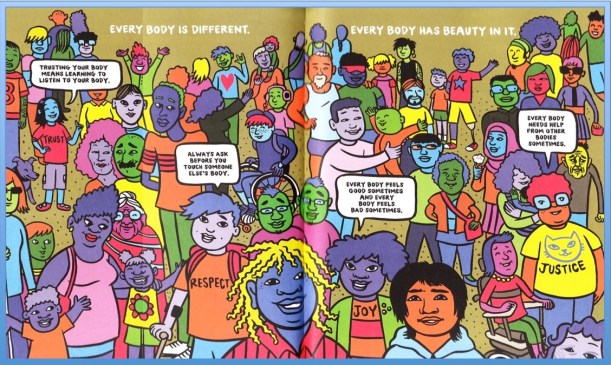
sex-is-a-funny-wordSex is a Funny Word: A Book About Bodies, Feelings, and You (2015), by Cory Silverberg and Fiona Smyth. This children’s book identifies the requisite body parts and touches very briefly on babymaking, but chiefly addresses feelings and relationships. It’s probably best suited to children ages 8-14, but readers outside that range will still find gold nuggets between the covers.

Its hallmark is the beautiful diversity of bodies. The challenge of displaying different skin tones is resolved by including skin colors from real life and technicolor faces. The faces shown display a variety of features; these people look like your friends – if you can imagine your friends with blue, green, and purple faces!

sex-is-a-funny-word
The book examines any number of emotionally complicated topics quite sensitively and sensibly. This is the book you wish you’d had when you started asking questions no one would answer.

Interestingly enough, the narrative voice that is progressive and inclusive enough to recognize the work of midwives and avoid giving health care providers sole credit for “delivering” the baby nevertheless fails to question a practice that is the epitome of doctor-patient power relationships:

When a baby is born, the doctor or midwife who helped it be born looks at its new naked body.
If they look down and see a penis, they say, “It’s a boy.”
If they look down and see a vulva, they say, “It’s a girl.”

Why is it necessary for a provider to pronounce the sex of the child? Under the midwife model of care, parents are empowered to make that discovery themselves. On reflection, the ultimate power of mainstream maternity care is that it provides parents with the sex of their child while it is still in utero. This realization, however, is more a critique of that power relationship than of this book.

Our library copy of this book included – charmingly – two to-do lists. One was clearly wedding-related (“gym/tanning” and “drop off wedding dress”). The other listed tasks connected with a camping trip. Perhaps the happy couple was planning for children on their honeymoon?

bottomlandBottomland (2016), by Michelle Hoover, follows a German-American family of Iowa farmers at the end of the first world war. One night, two of the family’s daughters disappear from the house. What can have happened to them? Their older brother seeks them in Chicago while the remaining family deals with the hostility of their community that thirsts for answers about the death of a generation of sons in the war. Beautifully written, and takes advantage of the historical context of the story.

life-after-life

How it was possible for us to miss one of our favorite author’s books from way back in 2013, we don’t know. Life After Life, by Kate Atkinson, explores the life of Ursala Todd, born in England in 1910, by means of a multiple chapters titled “Be Ye Men of Valor,” Snow,” “War,” “Armistice,” “Peace,” and “A Lovely Day Tomorrow,” among others. In some pattern that is difficult to discern, these chapters draw out a common event that leads to different endings, in the context of the era spanning two world wars. The point, of course, is the twin roles of chance and choice in our lives.  This is a book that should be read multiple times, in order to tease out the intricacies of Atkinson’s plot(s)!

the-gilded-hour

Sara Donati is another favorite author, for her Wilderness series, “six historical novels that follow the fortunes of a group of families living in upstate New York from about 1792-1825.” Her faithful readers rejoiced when Donati announced a new series, beginning with The Gilded Hour (2015), set in 1883 New York. Historical figures grace the pages of this novel, most notably Anthony Comstock, of the Comstock Laws that prohibited distribution of contraceptives, making The Gilded Hour a fine book to read alongside Terrible Virtue (see above). Like the Wilderness series, this newest novel portrays the work life and love life of one woman, within the context of her historical surroundings and fictional community. Readers can expect details on Dress Reform, midwifery and medicine, America’s melting pot/salad bowl, and the rights and restrictions women experience in making families for themselves.

the-long-way-homeWe experienced Louise Penny’s The Long Way Home (2014) by way of audiobook, as read by the late Ralph Cosham. Her tenth novel featuring the Québécois sleuth, Inspector Armand Gamache, it concerns the disappearance from the village of Three Pines one half of an artist couple, Peter Morrow. Peter’s wife Clara journeys with Gamache into the far reaches of Canada to search for Peter. This novel features a quest, a mystery that turns on the artist’s identity, and, as usual, brie on every sandwich.



Happy reading to all! Remember to support your public library by borrowing often to boost circulation figures. Michigan residents with participating libraries should remember the Michigan ELibrary is able to quickly place interlibrary loans and put many top-grade collections within our reach.


Bookshelf graphic is in the public domain, from http://www.publicdomainpictures.net/view-image.php?image=162504&picture=bookshelf-with-books.


1 Comment

Life begins … when?

Many have been known to ask when life begins, in an attempt to establish boundaries for policy issues connected with female reproduction. We wonder whether that question can possibly give a sufficiently definitive answer to guide us in our quest. If it can’t, we might do better to turn to some other defining scheme – such as the wishes of the mother whose body stands between the world and the baby-to-be.

life begins … when?, slide1

Explanations and Attributions

The spherical building welcoming the sperm is in real life the “Kugelmugel,” a micronation located in Vienna.

The clock radio photo, by Chrissy Wainwright, is titled “It’s Too Early!” It is shared here under a Creative Commons license.

The dugout photo demonstrating implantation is by Christian Bickel, described as “Speisekammern in Keldur” (food chamber – probably storage – in Keldur). It shows an example of an Icelandic turf house.

The photo representing red menstrual waters is by Derek Harper, entitled “Red Sea at Babbacombe.” It is shared here under a Creative Commons license.

The pink building shown in Frame 4 is, of course, the Jackson Women’s Health Organization, in Jackson Mississippi, where the awe-inspiring Dr. Willie Parker practices.

The court cases mentioned on Page 2 are quite well-known and easily found online, should you wish to read the opinions. No cases are mentioned for the criminalization of pregnancy (Frame 4), but a visit to National Advocates for Pregnant Women will tell you all you need to know.

The adorable baby with doting mama were captured by Bonnie U. Gruenberg. The photo is shared here under a Creative Commons license.

The orange chair and other clipart were taken from cliparts.co.

The statue shown in Frame 4 on Page 2 is of unknown origin, although several photos of it can be found online, including here, where it is suggested the statue depicts (biblical) Rachel weeping for her children.

The police officer and the representation of the Big Bang are shared here under a Creative Commons license.


Updated November 2, 2017, to fix a typographical error.


Bathrooms and equal rights

We present an updated graphic that was published on Facebook three months ago.  The comments in the middle frame were taken directly from Michigan’s official state website, but were edited for brevity. Unfortunately, the comments are no longer visible on the state website, but some of the comments have been preserved here.

The photo in the last frame is of a young Phyllis Shlafly. To be fair, it was her followers rather than she who are credited with bringing up unisex bathrooms; nevertheless, we put those words in her mouth as authorized by our artistic license.

[Updated July 16, 2016, to add copyright designation.]


Baby addicts?

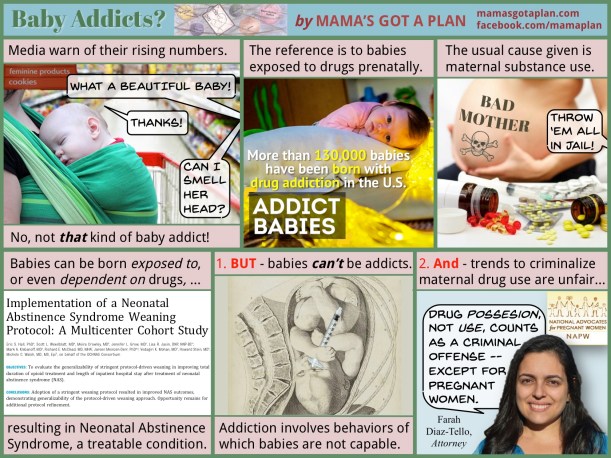
baby addicts, p1 baby addicts, p2

The condition of suffering babies is something everyone can comfortably decry. Sources like the video These Babies Were Born Addicted to Drugs rush to tell us how many babies are afflicted and how worthy of condemnation are their mothers for using drugs – usually opioids – while pregnant. The babies’ symptoms – trembling, shrill cries – are described in great detail. One cannot help feeling that any woman who would subject her baby to such a fate must be a monster.

The only problem is the facts. Babies suffering from Neonatal Abstinence Symptom can and are treated. The symptoms of NAS are often conflated with those of poverty or alcohol and tobacco use. More to the point, to describe babies as addicts is incorrect. Addiction is defined as “a chronic, relapsing brain disease that is characterized by compulsive drug seeking and use, despite harmful consequences.” One cannot accuse babies or fetuses, for that matter, of drug-seeking behavior. Rather, babies whose mothers used substances while pregnant can best be described as drug-exposed or drug-dependent.

To criminalize mothers for their pregnancy outcomes based on substance use is neither just nor effective. Typically, drug possession is a chargeable offense, not drug use. However, in the case of pregnant women, drug use, as determined by drug testing of mothers or newborns, is treated as a crime. Medical providers often fail to inform by their pregnant patients that they are being tested for substances; this is more likely to be the case for those receiving publicly-funded health care. Although health care providers are not permitted to test pregnant people for the express purpose of informing law enforcement, they may nevertheless use maternal testing as a screening mechanism to determine which newborns will be tested. Many states require providers in their role of mandatory reporter to report all such cases to child welfare agencies, who are then free to refer cases for criminal charges.

Prosecuting parents for prenatal drug use is of little benefit. Incarceration is not known to improve the health of pregnant people or their babies. Indeed, while awaiting sentencing in a holding facility, these pregnant people might not receive any health care at all, much less substance treatment. Furthermore, incarceration almost invariably results in the separation of parent and child, an act with far greater negative consequences than most drug use.

Removal of children by child welfare authorities for parental drug use – including legal medical marijuana use! – is not in the best interest of children or parents. Other countries do not automatically assume that drug use renders parents unfit. Determinations of abuse and neglect should be made based on abuse and neglect.

Nor is state involvement equally visited upon the population. Disadvantaged groups, such as poor women and women of color, are more likely to be subject to reprisals based on drug use than are their wealthier white counterparts. However, the fear engendered by medical providers’ role in reporting drug use is sufficient to cause many pregnant people to avoid care altogether – hardly a public health good.

In the 1980s and 90s, media were abuzz with accounts of “crack babies,” children said to have been exposed to crack cocaine in utero. Dire predictions abounded regarding the eventual fate of these children. However, even at the time, it was known that other legal substances – such as tobacco – were much more harmful to fetuses than crack cocaine. Nevertheless, because the crack baby story fed into the War on Drugs initiative proposed by Ronald Reagan – itself a piece of social policy with scant evidence basis – and because it made for dramatic television, it led to severe consequences to many parents and children.

The insistence on condemning mothers of babies exposed to opioids may well be equally suspect. Drug addiction should be treated as a public health issue rather than as a criminal law issue, moves to reduce income inequality and racial bias will do more to aid mothers and babies than incarceration, and blaming women for their pregnancy outcomes will result in less liberty for women in all aspects of their reproductive lives.


[Photos of Farah Diaz-Tello, of National Advocates for Pregnant Women, and Cherisse A. Scott, of SisterReach, used with permission.]

[Updated 6/1/2016, 9:30pm, for grammar and stylistic changes, and again on 6/4/2016 and 9/2/2016. Updated 7/16/2016 with copyright designation.]


On Mama’s shelf

sdsStudents for a Democratic Society: A Graphic History, by Harvey Pekar, Gary Dumm, and Paul Buhle. As a member of the unnamed generation between the Baby Boomers and Gen. X, I’ve been told my whole life that I missed the best times: “Nothing has ever been as good as it was in 1968.” I thought I’d view that assertion through the lens of people who experienced 1968 politically. I have a new appreciation for the graphic novel; it’s perfect for this kind of story. I was surprised, though, that this isn’t really a linear history of SDS, but rather a series of stories about different personages, as told and illustrated by a number of authors.

righteousmindThe Righteous Mind: Why Good People are Divided by Politics and Religion, by Jonathan Haidt. I missed this book when it was published to great acclaim in 2012. Actually, I confess that I am not reading this – yet. I watched a 2013 video of Haidt speaking about his work. I’m interested in this topic because so much of my own work stretches across some big ideological divides. Within the home birth community are many members with extraordinarily different values – and yet we manage to work together toward common goals. I’d like to extend that dynamic to other areas.

intoourownhandsInto Our Own Hands: The Women’s Health Movement in the United States, 1969-1990, by Sandra Morgen. This is another important work I missed when it was published in 2002. I found it last month while looking at a history of the National Women’s Health Network on the organization’s website, although I can’t retrace the exact path now. I’m particularly looking forward to reading Chapter 6, “The Changer and the Changed: The Women’s Health Movement, Doctors, and Organized Medicine.”

brainstormBrainstorm: The Power and Purpose of the Teenage Brain, by Daniel M. Siegel. This book was recommended to me for its insight into teenage behavior. I’ve been a teenager, of course, but somehow the experience doesn’t always translate to parenting one. I suspect this is a book I’ll skim rather than read through, but I am immediately attracted to the subheading “Ambivalence, Emotional Confusion, and the Right Side of the Brain.” That sounds about right.

betmeBet Me, by Jennifer Crusie. As the cover might suggest, this is a lightweight, lighthearted book. The library catalog lists it under the subject heading Dating (Social customs) — Fiction. I’m listening to the audiobook in the car with great delight. If you see me driving around town alternately laughing and blushing, you’ll know what I’m listening to. Crusie’s characters excel at delivering the bon mot  – much like on West Wing, if you can imagine them substituting romance for politics: ““Statistics show that men are interested in three things: careers, sports, and sex. That’s why they love professional cheerleaders.” (See the remainder of the quote here.)

Happy reading to all. Remember, support your public libraries. Borrow often to boost their circulation figures! Michigan residents with participating libraries should remember the Michigan ELibrary is able to quickly place interlibrary loans and put some great collections within our reach.


Breastfeeding article posted on MSU bioethics blog

In Murphy’s Breast: Lactation Law and Advocacy in 2014, I discuss four instances in which breastfeeding parents found themselves affected by law and advocacy efforts last year. Many thanks to Michigan State University’s Center for Ethics and Humanities in the Life Sciences for inviting me to write this piece.

Special bonus for Mama’s Got a Plan readers: A fifth section of the post that had to be cut to meet length requirements is included below.  More is more!


 Section 2.5. The Sleeping Breast: We Really Think You Shouldn’t!

Public health recommendations have unwittingly discouraged breastfeeding by insisting on separating parents and babies during sleep, based on incomplete and sometimes outright faulty evidence. While maintaining breastfeeding depends on mothers’ ability to feed babies at night, the practice of bedsharing, common throughout the world, is discouraged in the U.S. for fear that sleeping parents will accidentally suffocate their babies. Many public health initiatives focus on procuring safety-rated cribs for newborns.

Proponents of bedsharing – and breastfeeding – have long held that while babies should sleep apart under certain conditions, such as having an impaired parent or one who smokes, in most cases infant safety increases when infants sleep in close proximity to their breastfeeding mothers, on an appropriate surface. The supposedly higher rate of Sudden Infant Death Syndrome (SIDS) attributed to bedsharing has been discredited by the presence of co-founding variables. Breastfeeding is believed to be protective against SIDS and, of course, in many other ways beneficial to infant health.

Evidence now shows that recommendations for separate infant sleep have actually harmed infant health. Parents who try to heed warnings to avoid bedsharing are more likely to fall asleep on couches or padded chairs with their infants; those surfaces are dangerous to infants, because babies may become trapped between their parents and padded crevices of the furniture.

How curious then that policy makers continue to emphasize “Safe Sleep” policies that equate deterrence from bedsharing with increased infant safety. Michigan went so far as to enact legislation that compels hospitals to advise new parents on infant sleep practices. To be fair, the law itself does not include a warning against bedsharing. It delegates the power to issue recommendations to the Michigan Department of Community Health – that persists in its prescription that babies sleep by themselves, on their back, without any items in their cribs. The law, having created additional liability for hospitals that fail to distribute safe sleep materials to their patients, excuses hospitals from such liability if they retain a “signed parent acknowledgment statement” of having received such materials.


You can read the article in its entirety here.


Inciting mommy wars

An article of dubious quality quotes President Obama’s remarks on improving daycare:

And sometimes, someone, usually mom, leaves the workplace to stay home with the kids, which then leaves her earning a lower wage for the rest of her life as a result.  And that’s not a choice we want Americans to make.

Then it misinterprets these remarks with this title: Obama on Moms Who Stay Home to Raise Kids: ‘That’s Not a Choice We Want Americans to Make.’

It troubles me that readers take the article at face value and allow discussion of it to devolve into an argument about whether it is “better” for mothers to stay at home with small children or to remain in the paid workforce. These arguments serve only to divide us and to keep us from uniting in support of policies that safeguard all families.

On the whole I believe that making sure families have access to quality daycare is a positive move. I do, however, find some things troubling in the President’s speech.

Choosing to stay home – whose choice?

We love that word “choice,” don’t we? Our lives are just one big candy store and we get to pick whatever we want.

eddy+lange

(L) Oliver Tarbell Eddy  (R) Dorothea Lange

The truth is that some people do get to pick, which is not to say that all their choices are necessarily desirable. And some people do not. For example, most people receiving government assistance are required to work outside the home. So if we do believe that it is “best” for children to have their mothers at home, clearly we have decided that some children do not deserve the best.

Equal pay for equal work – but what is work?

rosie the riveterPresident Obama supports equal pay for equal work, and I’m glad of it. But that is hardly a new proposition.

When parents leave the workforce in order to spend more time caring for their children, they are hardly leaving work behind – just paid work. We as a nation are reaping the benefit of these parents’ – mostly women’s – unpaid work. Just this week, the UN Special Rapporteur on extreme poverty called on countries “to recognize unpaid care work as a major human rights issue.”

If we really valued the work that is required to raise our children, we would fairly compensate anyone who took on this task: mothers, fathers, and traditional paid caregivers. These last are often parents themselves, struggling to afford care for their own children.

Many young parents do not consider that when forgoing wages in order to take care of children, they are also forfeiting future Social Security payments. Having children is the number one reason women in the U.S. fall into poverty – it’s easy to see why that is the case, but not why it should be.


Earning a lower wage for the rest of our lives – why?

Do we really believe that motherhood robs us of the ability to be competent workers? At the same time that we laud motherhood as being a difficult yet supremely worthwhile task?

People’s experience of parenthood differs, but it is hard to accept that everyone who makes cabinets or medicines or burgers or nuclear reactors somehow irrevocably loses the ability to do so after spending time with children. We can look to other countries that manage to not penalize women for taking time off work to raise children.

There is no reason we cannot adjust our national policy to support all parents – those who would like to be home with their children, those who would not, and those who want a little of both – regardless of whether they can finance these choices themselves or require government assistance to do so. In the end, parents know what is best for their families and should be able to make these decisions, free from mandates imposed on the basis of economics or skin color or profession. This is the third arm of Reproductive Justice: the freedom to raise our children in safe conditions and with dignity.

Are you listening, President Obama? I’ve just written your next speech for you. obama speaking


News and links, May 4, 2014

Please follow the Facebook page for Mama’s Got a Plan!