Mama's Got a Plan:

Maternity Care, Health Insurance, and Reproductive Justice


Baby addicts?

baby addicts, p1 baby addicts, p2

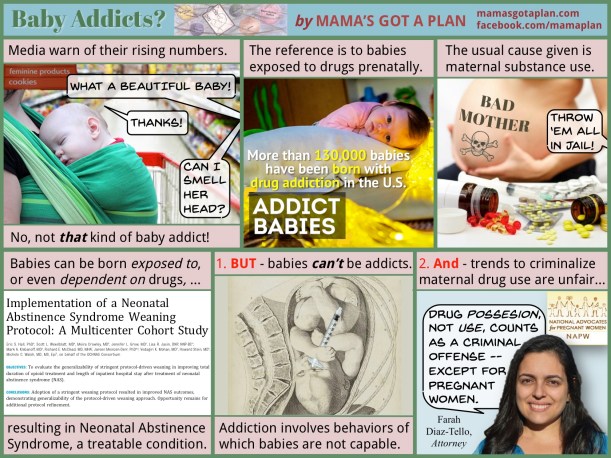
The condition of suffering babies is something everyone can comfortably decry. Sources like the video These Babies Were Born Addicted to Drugs rush to tell us how many babies are afflicted and how worthy of condemnation are their mothers for using drugs – usually opioids – while pregnant. The babies’ symptoms – trembling, shrill cries – are described in great detail. One cannot help feeling that any woman who would subject her baby to such a fate must be a monster.

The only problem is the facts. Babies suffering from Neonatal Abstinence Symptom can and are treated. The symptoms of NAS are often conflated with those of poverty or alcohol and tobacco use. More to the point, to describe babies as addicts is incorrect. Addiction is defined as “a chronic, relapsing brain disease that is characterized by compulsive drug seeking and use, despite harmful consequences.” One cannot accuse babies or fetuses, for that matter, of drug-seeking behavior. Rather, babies whose mothers used substances while pregnant can best be described as drug-exposed or drug-dependent.

To criminalize mothers for their pregnancy outcomes based on substance use is neither just nor effective. Typically, drug possession is a chargeable offense, not drug use. However, in the case of pregnant women, drug use, as determined by drug testing of mothers or newborns, is treated as a crime. Medical providers often fail to inform by their pregnant patients that they are being tested for substances; this is more likely to be the case for those receiving publicly-funded health care. Although health care providers are not permitted to test pregnant people for the express purpose of informing law enforcement, they may nevertheless use maternal testing as a screening mechanism to determine which newborns will be tested. Many states require providers in their role of mandatory reporter to report all such cases to child welfare agencies, who are then free to refer cases for criminal charges.

Prosecuting parents for prenatal drug use is of little benefit. Incarceration is not known to improve the health of pregnant people or their babies. Indeed, while awaiting sentencing in a holding facility, these pregnant people might not receive any health care at all, much less substance treatment. Furthermore, incarceration almost invariably results in the separation of parent and child, an act with far greater negative consequences than most drug use.

Removal of children by child welfare authorities for parental drug use – including legal medical marijuana use! – is not in the best interest of children or parents. Other countries do not automatically assume that drug use renders parents unfit. Determinations of abuse and neglect should be made based on abuse and neglect.

Nor is state involvement equally visited upon the population. Disadvantaged groups, such as poor women and women of color, are more likely to be subject to reprisals based on drug use than are their wealthier white counterparts. However, the fear engendered by medical providers’ role in reporting drug use is sufficient to cause many pregnant people to avoid care altogether – hardly a public health good.

In the 1980s and 90s, media were abuzz with accounts of “crack babies,” children said to have been exposed to crack cocaine in utero. Dire predictions abounded regarding the eventual fate of these children. However, even at the time, it was known that other legal substances – such as tobacco – were much more harmful to fetuses than crack cocaine. Nevertheless, because the crack baby story fed into the War on Drugs initiative proposed by Ronald Reagan – itself a piece of social policy with scant evidence basis – and because it made for dramatic television, it led to severe consequences to many parents and children.

The insistence on condemning mothers of babies exposed to opioids may well be equally suspect. Drug addiction should be treated as a public health issue rather than as a criminal law issue, moves to reduce income inequality and racial bias will do more to aid mothers and babies than incarceration, and blaming women for their pregnancy outcomes will result in less liberty for women in all aspects of their reproductive lives.


[Photos of Farah Diaz-Tello, of National Advocates for Pregnant Women, and Cherisse A. Scott, of SisterReach, used with permission.]

[Updated 6/1/2016, 9:30pm, for grammar and stylistic changes, and again on 6/4/2016 and 9/2/2016. Updated 7/16/2016 with copyright designation.]


Another media fail on “home birth safety”

wapofail


The Washington Post receives an F for its particularly poor reporting on a new study by Janssen, et al., “Costs of Planned Home vs. Hospital Birth in British Columbia Attended by Registered Midwives and Physicians.” WaPo focused on an issue that was not the main subject of the study and, in addition, gave disproportionate weight to a known biased opinion.

  1. Safety, again. Even though Janssen cites four studies on the safety of home birth, WaPo chose to question safety in the title of its article. When we consider a medical system that has the only increasing maternal mortality rate in the developed world and an infant mortality rate that’s nothing to write home about, not to mention maternal morbidity, denial of maternal autonomy, and outright obstetric violence, it seems misplaced to focus – in the face of contrary evidence –  on safety issues in home birth.
  2. Whose controversy? “The practice is highly controversial in the United States,” writes the reporter. A more accurate characterization would be that the practice is highly controversial among some subset of doctors and medical interest groups. Other parts of the country find home birth to be perfectly normal and No Big Deal.
  3. Licensure. And yet, considerable column inches are given to Amos Grunebaum, MD, a frequent critic of home birth, who states that Janssen’s Canadian study cannot apply to the U.S. because, “In the United States, there is no blanket licensing system for midwives.” He is correct. The reason? Federalism. There’s no blanket licensing system for physicians or nurses either! Each state has its own licensing regime.
  4. Licensure again, and that darn border. It’s strange that Grunebaum should object based on licensure as a key difference between Canada and the U.S., because Janssen particularly addresses how the differences in care systems might play out in the U.S., based on figures from Washington State, where midwifery care and medical care are well integrated.
  5. More about that border. Our neighbors to the north have a national health system and the U.S. does not – and that’s why we can’t talk about cost, apparently. Except …  50% of U.S. births are funded by Medicaid, a government health care system.
  6. Licensure again, and on not helping. “Only 28 states legally authorize midwives to practice, but in other states, Grunebaum said, midwives can practice with a high school education.” This statement is incorrect on multiple counts:
  • Thirty states legally authorize non-nurse midwives to practice.
  • Guess who chiefly opposes licensure in the remaining 20 states? The American Congress of Obstetricians and Gynecologists (ACOG) and state medical societies. It would be more logical for them to support midwife licensure if they are concerned about credentials and training, which, in Mama’s opinion, are reasonable things to be concerned about.
  • Yes, all midwives have a high school education … plus midwifery training. Just like other professions that are not academic professions –  army medics and commercial pilots, to name two.
  • “I don’t even call them midwives,” [Grunebaum] said. “They are ‘so-called midwives.'” This remark enters the territory of Just Plain Rude. It’s not for a physician to decide who is a midwife and who is not.

WaPo’s coverage is disappointing. They are capable of better. See for example this much more balanced article from Medical Daily. Shape up, WaPo! Stick to the point, and find a less biased expert!

Dear Reader, after reading that stressful list of faults, you deserve a reward. Take a look at the beautiful mamas and babies at Black Women Do VBAC and share in their unmistakable joy.


On Mama’s shelf

sdsStudents for a Democratic Society: A Graphic History, by Harvey Pekar, Gary Dumm, and Paul Buhle. As a member of the unnamed generation between the Baby Boomers and Gen. X, I’ve been told my whole life that I missed the best times: “Nothing has ever been as good as it was in 1968.” I thought I’d view that assertion through the lens of people who experienced 1968 politically. I have a new appreciation for the graphic novel; it’s perfect for this kind of story. I was surprised, though, that this isn’t really a linear history of SDS, but rather a series of stories about different personages, as told and illustrated by a number of authors.

righteousmindThe Righteous Mind: Why Good People are Divided by Politics and Religion, by Jonathan Haidt. I missed this book when it was published to great acclaim in 2012. Actually, I confess that I am not reading this – yet. I watched a 2013 video of Haidt speaking about his work. I’m interested in this topic because so much of my own work stretches across some big ideological divides. Within the home birth community are many members with extraordinarily different values – and yet we manage to work together toward common goals. I’d like to extend that dynamic to other areas.

intoourownhandsInto Our Own Hands: The Women’s Health Movement in the United States, 1969-1990, by Sandra Morgen. This is another important work I missed when it was published in 2002. I found it last month while looking at a history of the National Women’s Health Network on the organization’s website, although I can’t retrace the exact path now. I’m particularly looking forward to reading Chapter 6, “The Changer and the Changed: The Women’s Health Movement, Doctors, and Organized Medicine.”

brainstormBrainstorm: The Power and Purpose of the Teenage Brain, by Daniel M. Siegel. This book was recommended to me for its insight into teenage behavior. I’ve been a teenager, of course, but somehow the experience doesn’t always translate to parenting one. I suspect this is a book I’ll skim rather than read through, but I am immediately attracted to the subheading “Ambivalence, Emotional Confusion, and the Right Side of the Brain.” That sounds about right.

betmeBet Me, by Jennifer Crusie. As the cover might suggest, this is a lightweight, lighthearted book. The library catalog lists it under the subject heading Dating (Social customs) — Fiction. I’m listening to the audiobook in the car with great delight. If you see me driving around town alternately laughing and blushing, you’ll know what I’m listening to. Crusie’s characters excel at delivering the bon mot  – much like on West Wing, if you can imagine them substituting romance for politics: ““Statistics show that men are interested in three things: careers, sports, and sex. That’s why they love professional cheerleaders.” (See the remainder of the quote here.)

Happy reading to all. Remember, support your public libraries. Borrow often to boost their circulation figures! Michigan residents with participating libraries should remember the Michigan ELibrary is able to quickly place interlibrary loans and put some great collections within our reach.


Breastfeeding article posted on MSU bioethics blog

In Murphy’s Breast: Lactation Law and Advocacy in 2014, I discuss four instances in which breastfeeding parents found themselves affected by law and advocacy efforts last year. Many thanks to Michigan State University’s Center for Ethics and Humanities in the Life Sciences for inviting me to write this piece.

Special bonus for Mama’s Got a Plan readers: A fifth section of the post that had to be cut to meet length requirements is included below.  More is more!


 Section 2.5. The Sleeping Breast: We Really Think You Shouldn’t!

Public health recommendations have unwittingly discouraged breastfeeding by insisting on separating parents and babies during sleep, based on incomplete and sometimes outright faulty evidence. While maintaining breastfeeding depends on mothers’ ability to feed babies at night, the practice of bedsharing, common throughout the world, is discouraged in the U.S. for fear that sleeping parents will accidentally suffocate their babies. Many public health initiatives focus on procuring safety-rated cribs for newborns.

Proponents of bedsharing – and breastfeeding – have long held that while babies should sleep apart under certain conditions, such as having an impaired parent or one who smokes, in most cases infant safety increases when infants sleep in close proximity to their breastfeeding mothers, on an appropriate surface. The supposedly higher rate of Sudden Infant Death Syndrome (SIDS) attributed to bedsharing has been discredited by the presence of co-founding variables. Breastfeeding is believed to be protective against SIDS and, of course, in many other ways beneficial to infant health.

Evidence now shows that recommendations for separate infant sleep have actually harmed infant health. Parents who try to heed warnings to avoid bedsharing are more likely to fall asleep on couches or padded chairs with their infants; those surfaces are dangerous to infants, because babies may become trapped between their parents and padded crevices of the furniture.

How curious then that policy makers continue to emphasize “Safe Sleep” policies that equate deterrence from bedsharing with increased infant safety. Michigan went so far as to enact legislation that compels hospitals to advise new parents on infant sleep practices. To be fair, the law itself does not include a warning against bedsharing. It delegates the power to issue recommendations to the Michigan Department of Community Health – that persists in its prescription that babies sleep by themselves, on their back, without any items in their cribs. The law, having created additional liability for hospitals that fail to distribute safe sleep materials to their patients, excuses hospitals from such liability if they retain a “signed parent acknowledgment statement” of having received such materials.


You can read the article in its entirety here.


Midwife licensure in Delaware

crockett delaware licensureEmily Crockett of RH Reality Check wrote an excellent article on the state of direct entry midwifery in Delaware. She correctly identified the chief obstacle to practice: while the law requires these midwives to maintain collaborative agreements with physicians, physicians aren’t obligated to collaborate. The predictable result: no collaborative agreements and very few midwives who can legally practice.

How it works

A little additional context might be helpful to those wishing to understand how the law works and how it might be improved. First of all, let’s start by clearing up two terms that are often used interchangably, to everyone’s confusion:

  • Certification indicates that a certifying organization has confirmed an individual’s skills, training and education.
  • Licensure means that a state governments has granted a license to practice. Increasingly, state governments base licensure requirements on a specific certification.

For example: A direct entry midwife (i.e. a midwife who is not a nurse) successfully undergoes the education, training, and testing requirements to be certified by the North American Registry of Midwives as a Certified Professional Midwife (CPM). The certification alone does not permit her to practice legally in any state, any more than graduating from medical school allows a physician to practice legally. The midwife is lucky enough to live in Wisconsin, one of the twenty-six states in which CPMs can obtain a license. She applies for a license, pays her fee, and is able to practice under Wisconsin law. She must abide by the licensure requirements in statute as well as any rules that the governing state department or agency has promulgated regarding midwifery practice.

As long as we’re defining terms, let’s talk about different kinds of law:

  • Statutes are what ultimately result when your elected representatives pass legislation. Legislation is hard to pass and hard to amend, so anything that goes into statute should be something that is not expected to change too much over time.
  • Rules (or regulations) are exactly what they suggest: the practical directions for carrying out the legislature’s wishes as expressed in statute. Rules are typically written by whatever board or government department the executive branch of state government appoints or hires to oversee the practice authorized by the statute. Rules are often open to a public comment period or public hearing before they are finalized. Rules are much easier to change than statutes as they don’t need to be voted on in the legislature.

How it works in Delaware

Delaware is one of two states in which CPMs cannot obtain a license but are nevertheless legally authorized to practice. The extent of the authorization in statute is that the Delaware Department of Health and Social Services may issue regulations that:

Control the practice of non-nurse midwives including the issuance of permits and protect and promote the health of all mothers and children[.]  – Del. Code Ann. tit. 16, §122 (3)(h), emphasis added

In other words, the legislature left everything up to the Department of Health and Social Services, so most of the law that controls Delaware CPMs lives in the rules. And those rules, as outlined in Crockett’s article, require a collaborative practice agreement before a midwife can obtain a permit (note: not a license). As an aside, the rules require startlingly little else – the exact fee an applicant must pay, the kinds of births midwives may attend, the medications they may carry. None of these are specified, although there is a suggestion that some of these items fall under the collaborative agreement. It is possible, therefore, that the Department envisioned physicians as setting midwife standards of practice.

What’s the solution?

Current Delaware law may lead concerned parties to oppose regulating midwives. This is unfortunate, in my opinion, because the problem is not that midwives are regulated, but that they are regulated badly. Rather than being licensed as an independent profession, midwives are currently permitted to practice based on subordination to physicians. The remedy is full licensure – and that is exactly what advocates support in a bill currently active in the Delaware legislature.

The devil still remains in the details. Should the bill pass and become law, advocates must remain engaged throughout the process of rule promulgation in order to ensure that the rules are not restrictive to the extent that midwives are unable to practice.

Readers familiar with this issue may have noticed that I have failed to mention the safety of midwife-attended births. That may or may not be a subject for another post. However, in a sense it’s a moot point: the Delaware legislature obviously believes midwife-attended births are safe, because it passed legislation to permit midwives to practice under its constitutional and statutory duty is to protect the public’s health. Families will continue to have midwife-attended births; it is now the legislature’s duty to create an environment where midwives can practice under the protection and discipline of state law. At the end of the day, although licensure does not guarantee quality – just think of other health professions! or lawyers! – it does provide a structure where midwives’ qualifications are knowable and where midwives are subject to rules designed to keep parents and babies safe.


News and links, May 4, 2014

Please follow the Facebook page for Mama’s Got a Plan!


“[U]nconsented-to medical treatment is only generally a battery. Consent to a particular procedure may be “inferred from the patient’s action of seeking treatment or some other act manifesting a willingness to submit to a particular course of treatment.” [internal cite omitted]. Here, Carol came to the hospital for the purpose of medical treatment: the birth of Mikayla. The complaint itself admits that Carol had used marijuana and methamphetamines the week before giving birth to Mikayla. […] Insofar as we can determine from the pleadings and the record, Carol did not at any time communicate to any personnel at the hospital that she wished not to be tested for drugs. Testing Carol for drugs without first obtaining her consent did not constitute a battery here, where Carol unambiguously consented to the course of treatment — the birth of Mikayla — pursuant to which the drug test was conducted, and where Carol in no way communicated a desire not to be tested.”

I ran across the text above when looking for something else entirely in Michigan case law. In the 2008 case of Jodis v. Brubaker, the Michigan Court of Appeals apparently felt that when you enter a hospital to give birth, you automatically consent to anything your providers think is necessary, unless you explicitly tell your providers you do not consent to that procedure they haven’t told you about.

I will leave it to your imagination as to how this might play out for people in labor and what would happen if this scenario were extended to any other class of people seeking medical care.

What we have here is neither informed nor consent.


C-section rate a little high? You think?

Social networks are abuzz this week following the publication of the article, “Safe Prevention of the Primary Cesarean Delivery,” developed by ACOG (the American College of Obstetricians and Gynecologists) and the Society for Maternal-Fetal Medicine. ImageThe gist of the article is that the U.S. c-section rate, hovering somewhere around 25% of first-time births (and 33% of all births), is too high and measures should be taken to lower it. I couldn’t agree more.

However, before I fall all over myself congratulating ACOG for its perspicacity, I’d like to call attention to a few truths it has omitted. Commence strategic changes of headgear now!

Image Late to the party

Members of the overlapping midwifery, physiologic birth, and maternity care reform communities have been warning of the dangers of the rising c-section rate for decades. Because of c-sections’ greater risk of injury to both mother and baby as well as the consequent restrictions on mothers’ fertility, many advocates have emphatically sounded this warning for a long time. I think it’s fair to say that gladness reigns in these communities that ACOG has finally gotten the memo, but many of us would have been happier to see ACOG acknowledge its long delay in coming to these conclusions.

In fact, it would have been reasonable for ACOG to concede that perhaps these communities might be correct in some other stances as well:

  • MIdwives are widely acknowledged to be experts in lowering c-section rates, but the word “midwife” appears nowhere in the article. Doulas are mentioned in the context of the benefits of “the presence of continuous one-on-one support during labor and delivery.” However, overlooked is the reason why doulas are necessary: hospitals fail to provide continuous one-on-one support for their pregnant patients. Everyone is familiar with the obstetrician who swoops in at the last moment to catch the baby, but many new parents are not aware that labor and delivery nurses will for the most part be monitoring multiple patients’ fetal monitoring traces from a computer in another room. If ACOG is serious about lowering the c-section rate, it needs to get behind a model of care that can accomplish this. Rather than making patients responsible for providing their own support personnel at added cost, hospitals should step up by establishing and increasing midwifery services and empowering midwives to practice autonomously. As a bonus, hospitals could incorporate doula services.
  • Out-of-hospital midwives, particularly when they are direct-entry midwives rather than nurse-midwives, have long faced hostility from ACOG. It’s time for ACOG to recognize that families plan out-of-hospital births for many reasons, and that no amount of censure by obstetricians will change that. If ACOG is serious about lowering the c-section rate and improving the U.S.’s abysmal maternity and infant mortality rate, it should be falling over itself to learn from these midwives who are experts in protecting physiologic birth. It would also be a show of good faith if ACOG recommended protocols for hospital for receiving appropriate home birth transfers, as home birth is made safer if smooth transfers are a given. Finally, ACOG might consider throwing its political might behind state legislative measures to license direct-entry midwives and to permit nurse-midwives to practice autonomously to their full scope of practice.
  • While the article addressed limits on interventions such as inductions that are known to increase the number of c-sections, it left out others of the other widely acknowledged healthy birth practices, including encouraging patients in labor to move around and to avoid giving birth on their backs, and to refuse unnecessary interventions shown to increase c-sections, such as continuous electronic fetal monitoring.

Overall, I would remind ACOG that its members are experts in performing c-sections – and thank goodness, because this surgery can be life-saving. But to reduce the number of c-sections, ACOG would do well to look elsewhere for guidance.

ImageCausation, correlation, and stigma

It’s not only Weight Watchers, the First Lady, supermarket tabloids, and everyone’s family members who shame people for their size; medicine jumped on this bandwagon a long time ago. It is rare for a research study examining some aspect of pregnancy or childbirth to avoid blaming fat women for increased risk. The ACOG article doesn’t disappoint:

A large proportion of women in the United States gain more weight during pregnancy than is recommended by the Institute of Medicine (IOM). Observational evidence suggests that women who gain more weight than recommended by the IOM guidelines have an increased risk of cesarean delivery and other adverse outcomes. In a recent Committee Opinion, the College recommends that it is “important to discuss appropriate weight gain, diet, and exercise at the initial visit and periodically throughout the pregnancy.”  Although pregnancy weight-management interventions continue to be developed and have yet to translate into reduced rates of cesarean delivery or morbidity, the available observational data support that women should be counseled about the IOM maternal weight guidelines in an attempt to avoid excessive weight gain. (Citations removed)

While to the uninitiated this paragraph might seem eminently sensible, I invite you to consider the following thoughts:

  • The correlational evidence between weight gain and increase in c-sections is somewhat less than solid, by ACOG’s own admission. Even if the correlation were solid, it doesn’t mean that managing weight gain would resolve the problem – after all, the weight gain and adverse outcomes might both be caused by some third factor. Finally, even if causation were shown, there are vast amounts of evidence to show that in general, trying to control weight through restrictive eating and increased exercise is a losing game. In pregnancy, restricting intake may well have harmful effects on the child. One of the best sources for information on these matters is Pamela Vireday’s website, The Well-Rounded Mama.
  • Vireday also points out that adverse pregnancy outcomes for fat women can at least partially be attributed to weight bias-influenced pregnancy management practices. In addition, the effects of stigma as physiological mechanisms are beginning to be known; these effects might also account for some outcome disparities. Rather than demanding that pregnant patients their weight, providers might instead refrain from practices rooted in bias that increase stigma.
  • Finally, because poor nutrition and too much or too little exercise can be bad for people of all shapes and sizes, it would be more reasonable – and easier! – for practitioners to recommend good nutrition and appropriate exercise to all their patients rather than to target fat patients with weight control advice. This approach is in fact a feature of midwifery-led care and of the Health at Every Size philosophy.

However inured we have become to messages positioning fat as the the next Great Terror, I suggests we think critically about fairness, practicality, and evidence when making recommendations about what size or shape pregnant people should be.

Image Let’s blame all the lawyers

Physician anxiety over potential medical malpractice liability is a frequent topic when practice reforms are under discussion, particularly in the high-stake field of obstetrics. The typical solution proposed is tort reform – specifically, legislature-imposed caps on damage awards to injured parties. ACOG falls right into step:

A necessary component of culture change will be tort reform because the practice environment is extremely vulnerable to external medico-legal pressures. Studies have demonstrated associations between cesarean delivery rates and malpractice premiums and state-level tort regulations, such as caps on damages.  A broad range of evidence-based approaches will be necessary––including changes in individual clinician practice patterns, development of clinical management guidelines from a broad range of organizations, implementation of systemic approaches at the organizational level and regional level, and tort reform––to ensure that unnecessary cesarean deliveries are reduced.  (Citations removed and emphasis added)

Caps on damages, currently in place in a majority of states, can certainly lower the costs negligent physicians pay in damage awards and thus lower anxiety about liability, which in turn may lead to fewer c-sections. However, this strategy is akin to alleviating a family’s anxiety about its grocery bills by having it cut out breakfast and dinner each day: it solves one problem while creating a much more serious one.

The civil justice (“tort”) system enables individuals to obtain redress for civil wrongs without deploying government to do so; once a state government has established the necessary courts and basic rules of the game, private entities move the action along. Accordingly, the civil justice system is one of the few arenas in which individuals have the power to challenge negligent behavior of large, influential entities. In the realm of medical malpractice litigation, this capacity is further facilitated by the contingency fee arrangement that allows litigants to engage an attorney without paying a retainer fee. Attorneys front the costs of cases and receive payment only if the case is successful.

To limit the amount of damages awarded by juries is to undercut the redress that injured individuals can receive. If medicine wishes to avoid malpractice liability, numerous solutions are available:

  • Refrain from committing malpractice!
  • Eliminate the need for compensation. If families with babies injured at birth could be sure that the care required for the rest of the children’s lives would be available and accessible to them, one economic motivation for bringing suit would be removed. The considerable power of the medical lobby should be brought to bear on strengthening and broadening collective systems that compensate victims of illness, injury, and disability, such as Medicare and Social Security.
  • An approach pioneered by the University of Michigan demonstrates that liability after adverse events can be reduced when medical institutions provide 1. open communication and record sharing with patients, 2. early offers to settle when the institution is at fault and corresponding refusal to settle when not at fault, and 3. (if the institution is at fault) systemic changes, so the error is not repeated.

The three points above have been made before, and by wiser heads than mine. Rarely discussed, however, is the relative powerlessness of mothers to use the tort system to discourage non-medically-indicated c-sections. As the c-section has grown to an ever-greater proportion of American births, its potential harms have been increasingly played down, particularly those harms that are not apparent until subsequent pregnancies. As a result, projected damage awards are insufficient to induce plaintiffs’ attorneys to mount such cases and tort law thus fails to fulfill one of its functions of a feedback system to deter unsafe medical practices.

In “Distorted and Diminished Tort Claims for Women,” Jamie Abrams contends that tort law has come to privilege the claims of injured babies over those of their mothers in a way that “diminish[es] the birthing woman as a patient and a putative plaintiff.” She connects this primacy of the fetus as patient and plaintiff with the decline of the mother’s role as decision-maker for herself and the fetus. Among her recommendations to reverse this trend, Abrams suggests that “more pursuits of maternal harms claims are necessary. Even if the ultimate damage verdicts are nominal, the pursuit of damages will push courts to consider more carefully the harms to mothers and perhaps influence the standard of care.” If such actions could normalize for attorneys, judges, and juries the idea that unwanted and non-medically-indicated c-sections constitute harm to pregnant patients, just as the ACOG article finally admits, this might re-establish a remedy for patients who have suffered these harms. Furthermore, the tort system’s feedback function would then re-emerge to provide a counterweight to physicians’ traditional concerns that not performing c-sections exposes them to liability.

* * * * *

ImageIn summary, I congratulate ACOG on joining the party, however late, and urge it to mingle with all the guests, giving credit where credit is due. If ACOG can acknowledge the knowledge and experience of pregnant people, midwives, and yes, even lawyers, we might all join together to reverse the mounting c-section trend and make a safer world for parents and babies – and a less anxious one for physicians as well.

Not my usual topic, but not as far removed as you might think

Abortion rights article is not just about abortion!

My most recent article, “Michigan’s New Abortion Insurance Rider Law: Challenges, Spin, and Justice,” is now available on the blog of Michigan State University’s Center for Ethics and Humanities in the Life Sciences.

Although abortion rights is not my usual focus, fans of Mama’s Got a Plan may wish to read the article to the end to see how I tie abortion rights into the larger context of Reproductive Justice and then – presto! chango! – discuss the relevancy to my favorite topic of rights in pregnancy and childbirth.

Other content at MSU

MSU allowed me a great deal of freedom in constructing the article, for which I’m very grateful. I’d also like to thank them for inviting me to speak last year on the topic of vaginal birth after cesarean. The talk, The Declining Provider: Refusal, Responsibility, and Reasonableness, is still available as a free webinar.

Coming soon

  • Fun pop culture post
  • Custom-drawn blog header

Stay tuned!